
AquaLab: The Decision Support System for Sustainable Marine Aquaculture
2022 – 2025
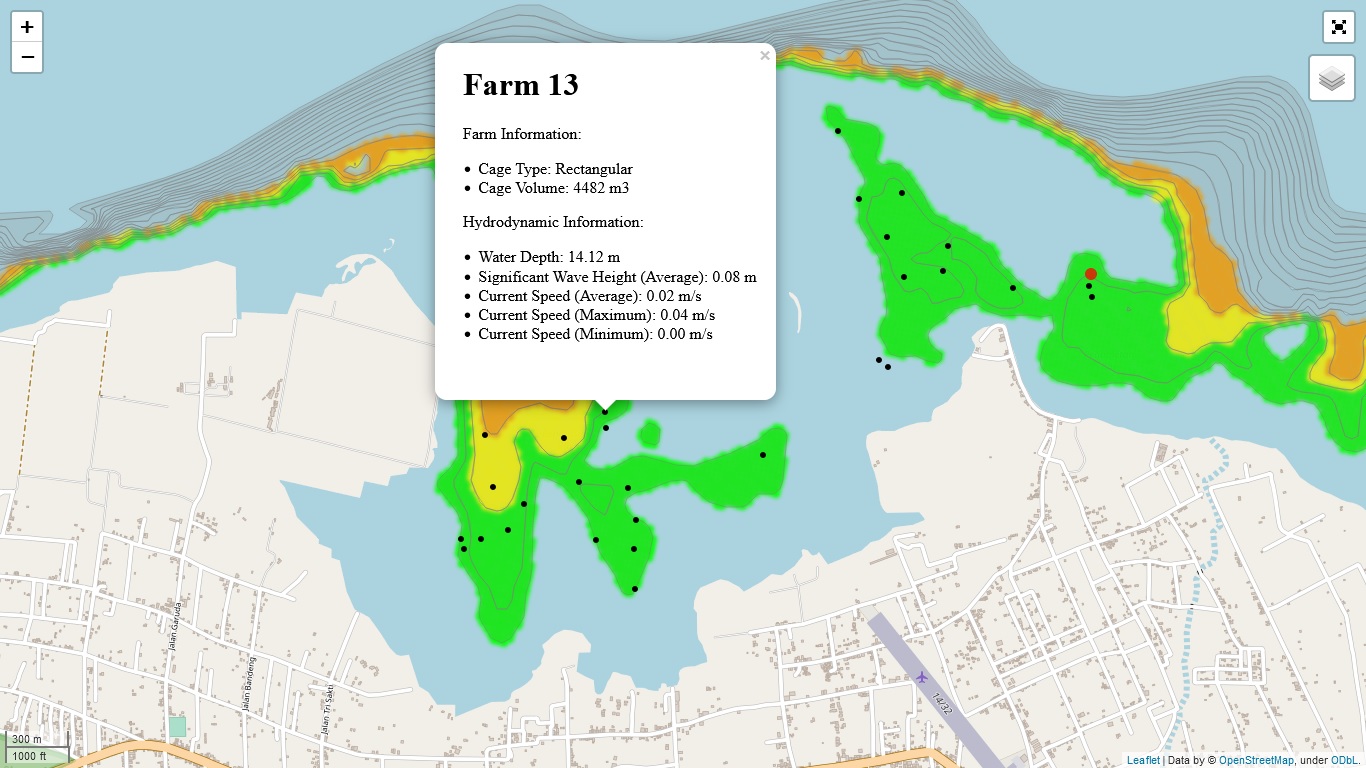
Developed a Windows application in Python that integrates data from operational ocean prediction systems, field observations, and coastal numerical models to support researchers, policy-makers, and engineers in making informed decisions for sustainable marine aquaculture development.
The deliverables of the project were:
• User-friendly interface for database management and visualization
• Site Suitability module
• Production Carrying Capacity module
• Ecological Carrying Capacity module
Erschließungsstrategien zur Identifizierung, Bewertung und Nutzung dichtegetriebener Meeresströmungen zur Stromerzeugung durch Turbinen
2022 – 2023
“Development strategies for identifying, evaluating and utilizing density-driven ocean currents for power generation by turbines”
Contributed to and co-supervised a project assessing the energy yield potential of the non-tidal, stratified, and bi-directional Bosphorus Exchange Flow. Planned and conducted field measurements of multiple MetOcean parameters, including ADCP and CTD chain observations. Co-developed the ‘Bosphorus Circulation Model (BCM)’ and the resource assessment algorithm ‘ARA.’ Key findings were published in the journal Renewable Energy.
Project partners:
• Research and Technology Centre (FTZ)
• Yıldız Technical University
Funding: Deutsche Bundesstiftung Umwelt (DBU)

SAM19: Smartes Autonomes Frühwarnsystem zum Management von Schadensrisiken bei Offshore Meeres-Fischzuchtanlagen in Asien
2019 – 2022
“Smart Autonomous Early Warning System to Protect Offshore Fish Farms against Hazards in Asia”
Co-developed an early-warning system that integrates operational ocean prediction systems, hydrodynamic models, and in-situ monitoring to autonomously simulate key MetOcean parameters—including wind climate, wave characteristics, and hydrodynamic conditions—to predict and mitigate storm hazards for fish farms.
Project partners:
• Research and Technology Centre (FTZ)
• Sea & Sun Technology
Funding: German Federal Ministry for Economic Affairs and Energy (BMWi)

EMS IV: Planung Großschiffsliegeplatz Emden: Wasserbauliche Systemanalyse Los 6.2
2015 – 2016
“Hydraulic System Analysis for the Proposed Mega-Ship Berth”
Contributed to hydraulic system analysis using numerical modeling to support planning for dredging around the navigation channel and constructing a pier and berth to accommodate larger ships at Emden Harbor, Lower Saxony, Germany. Integrated planned marine structures into the Ems Estuary hydrodynamic model and analyzed morphodynamic simulations to evaluate potential changes in coastal dynamics from the proposed developments. Findings were published in a detailed technical report.
Project partners:
• Research and Technology Centre Westcoast (FTZ)
• Niedersachsen Ports GmbH & Co. KG
Funding: Lower Saxony Water Management, Coastal Defense and Nature Conservation Agency (NLWKN)

SPICE III: Science for the Protection of Indonesian Coastal Marine Ecosystems
2012 – 2016
“SPICE III Topic 6: Ocean Renewable Energy ORE-12“
This project addressed key research gaps in characterizing tidal current energy resources and estimating effective power from tidal currents, with a focus on Indonesia. It aimed to develop a reliable information base and high-resolution analysis tools, alongside advanced strategies for resource characterization, particularly for data-poor sites. As the assessment relied primarily on model simulations, guidelines for developing dynamic models were provided. Investigations focused on several straits linking the inner Indonesian Seas with the Indian Ocean. Given their technological maturity, horizontal-axis tidal turbines were considered throughout the study. The proposed methodology was integrated into a decision support system (DSS) to facilitate analysis and decision-making. Application of the DSS to government-prioritized straits demonstrated its capability to estimate tidal current power potential in the most promising locations.
The findings were summarized in a book article.
Project partners:
• Research and Technology Centre Westcoast (FTZ)
• German Aerospace Centre (DLR)
• Voith Hydro Ocean Current Technologies
• Agency for the Assessment and Application of Technology, Indonesia (BPPT)
• Ministry of Marine Affairs and Fisheries, Indonesia (KKP)
Funding: German Federal Ministry of Education and Research (BMBF) and the Chinese Academy of Sciences


Interaction between the flow and the horizontal axis tidal turbines (Image: Kadir Orhan ©)
 Dr. Kadir Orhan